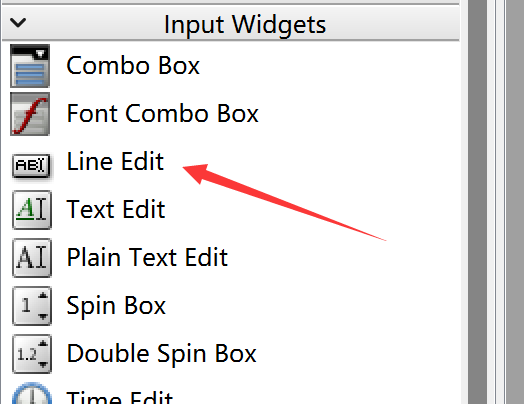
LineEdit (Single-line Text Box)
Introduction
The single-line text box allows users to input a single line of text.
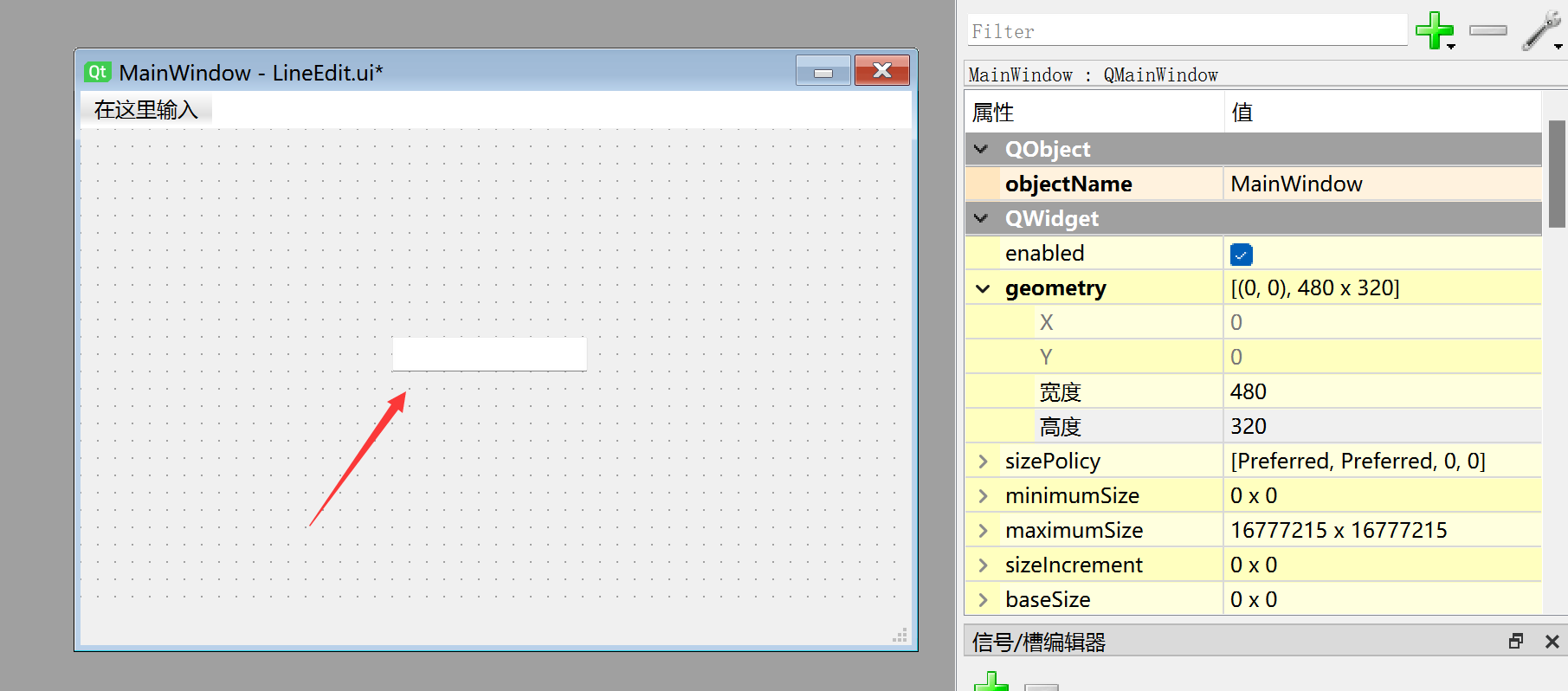
Double-click to add preset display content to the text box, and drag the edges to resize. Font size and other properties can be configured in the right-side properties panel.
The Python code generated from this window is as follows:
# -*- coding: utf-8 -*-

from PyQt5 import QtCore, QtGui, QtWidgets

class Ui_MainWindow(object):
    def setupUi(self, MainWindow):
        MainWindow.setObjectName("MainWindow")
        MainWindow.resize(480, 320)
        self.centralwidget = QtWidgets.QWidget(MainWindow)
        self.centralwidget.setObjectName("centralwidget")
        self.lineEdit = QtWidgets.QLineEdit(self.centralwidget)
        self.lineEdit.setGeometry(QtCore.QRect(180, 120, 113, 20))
        self.lineEdit.setObjectName("lineEdit")
        MainWindow.setCentralWidget(self.centralwidget)
        self.menubar = QtWidgets.QMenuBar(MainWindow)
        self.menubar.setGeometry(QtCore.QRect(0, 0, 480, 22))
        self.menubar.setObjectName("menubar")
        MainWindow.setMenuBar(self.menubar)
        self.statusbar = QtWidgets.QStatusBar(MainWindow)
        self.statusbar.setObjectName("statusbar")
        MainWindow.setStatusBar(self.statusbar)

        self.retranslateUi(MainWindow)
        QtCore.QMetaObject.connectSlotsByName(MainWindow)

    def retranslateUi(self, MainWindow):
        _translate = QtCore.QCoreApplication.translate
        MainWindow.setWindowTitle(_translate("MainWindow", "MainWindow"))
The code related to the single-line text box is as follows:
# -*- coding: utf-8 -*-

from PyQt5 import QtCore, QtGui, QtWidgets


class Ui_MainWindow(object):
    def setupUi(self, MainWindow):
        ...
        self.lineEdit = QtWidgets.QLineEdit(self.centralwidget)
        self.lineEdit.setGeometry(QtCore.QRect(180, 120, 113, 20)) # Text box x, y, width, height
        self.lineEdit.setObjectName("lineEdit") # Set text box object name, not display name
QLineEdit Object
| Common Methods | Description |
|---|---|
| setText() | Set text box content |
| Text() | Get text box content |
| clear() | Clear text box content |
| setMaxLength() | Set maximum allowed input character length |
| Common Signals | Description |
|---|---|
| textChanged | Triggered when text box content changes |
| editingFinished | Triggered when editing is finished by pressing the Enter key |
Example
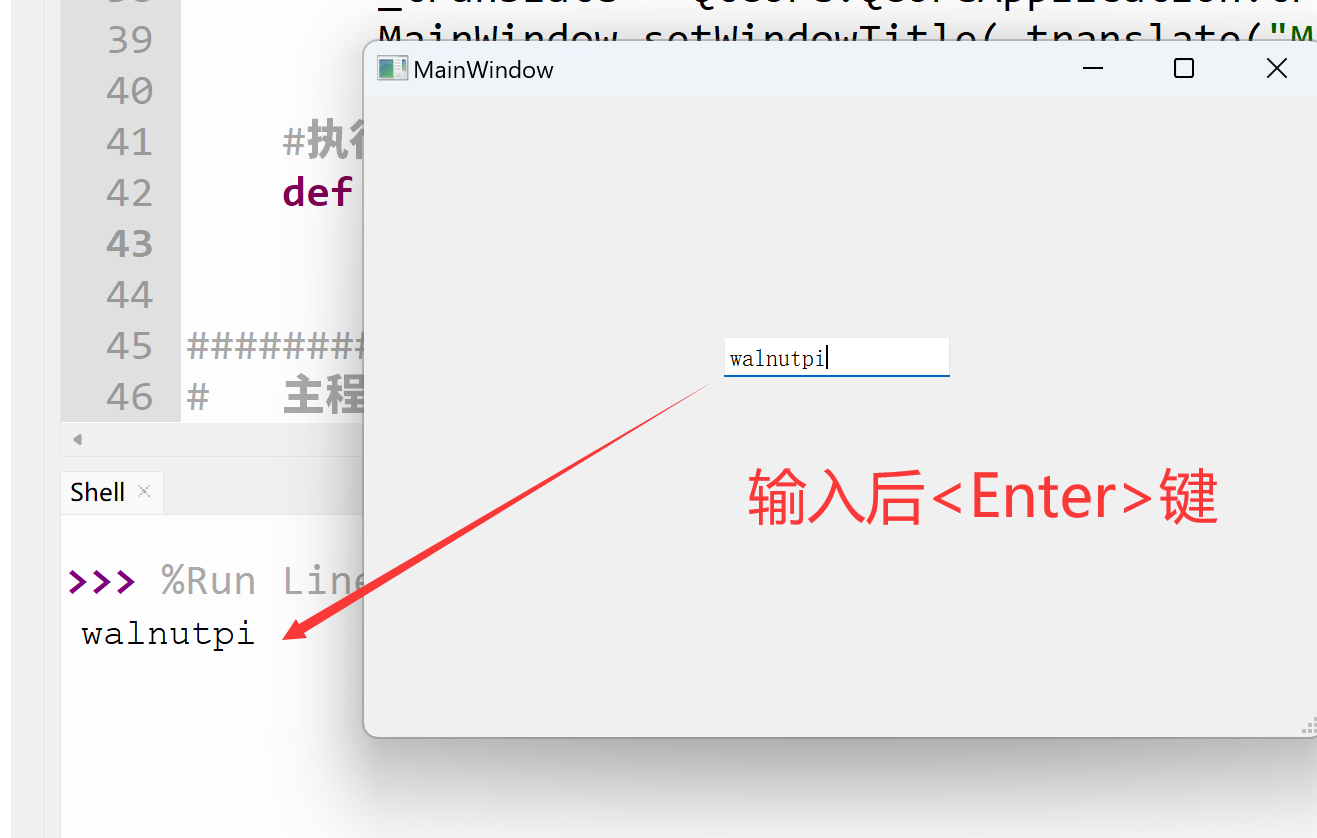
Example: When the user finishes typing in the text box and presses Enter, print the input content to the terminal.
Use the editingFinished signal to detect when input is complete. Add the following after self.retranslateUi(MainWindow):
self.lineEdit.editingFinished.connect(self.fun) # Editing finished, triggered by pressing <Enter>
Then add the function to be executed inside the Ui_MainWindow class. Here, it prints information to the terminal:
# Execution function
def fun(self):
    print(self.lineEdit.text())
The complete code is as follows:
# -*- coding: utf-8 -*-

from PyQt5 import QtCore, QtGui, QtWidgets


class Ui_MainWindow(object):
    def setupUi(self, MainWindow):
        MainWindow.setObjectName("MainWindow")
        MainWindow.resize(480, 320)
        self.centralwidget = QtWidgets.QWidget(MainWindow)
        self.centralwidget.setObjectName("centralwidget")
        self.lineEdit = QtWidgets.QLineEdit(self.centralwidget)
        self.lineEdit.setGeometry(QtCore.QRect(180, 120, 113, 20))
        self.lineEdit.setObjectName("lineEdit")
        MainWindow.setCentralWidget(self.centralwidget)
        self.menubar = QtWidgets.QMenuBar(MainWindow)
        self.menubar.setGeometry(QtCore.QRect(0, 0, 480, 22))
        self.menubar.setObjectName("menubar")
        MainWindow.setMenuBar(self.menubar)
        self.statusbar = QtWidgets.QStatusBar(MainWindow)
        self.statusbar.setObjectName("statusbar")
        MainWindow.setStatusBar(self.statusbar)

        self.retranslateUi(MainWindow)
        #self.lineEdit.textChanged.connect(self.fun) # Text box content changed
        self.lineEdit.editingFinished.connect(self.fun) # Editing finished, triggered by pressing <Enter>
        QtCore.QMetaObject.connectSlotsByName(MainWindow)

    def retranslateUi(self, MainWindow):
        _translate = QtCore.QCoreApplication.translate
        MainWindow.setWindowTitle(_translate("MainWindow", "MainWindow"))

    # Execution function
    def fun(self):
        print(self.lineEdit.text())

#################
#   Main Program Code   #
#################
import sys

#【Optional Code】Allow Thonny remote execution
import os
os.environ["DISPLAY"] = ":0.0"

#【Optional Code】Fix display issues on monitors with 2K+ resolution
QtCore.QCoreApplication.setAttribute(QtCore.Qt.AA_EnableHighDpiScaling)

# Program entry point: build the window and display it
app = QtWidgets.QApplication(sys.argv)
MainWindow = QtWidgets.QMainWindow() # Build window object
ui = Ui_MainWindow() # Build PyQt5-designed window object
ui.setupUi(MainWindow) # Initialize window
MainWindow.show() # Display window

#【Recommended Code】Allow terminal to interrupt window with ctrl+c for easier debugging
import signal
signal.signal(signal.SIGINT, signal.SIG_DFL)
timer = QtCore.QTimer()
timer.start(100)  # You may change this if you wish.
timer.timeout.connect(lambda: None)  # Let the interpreter run each 100 ms

sys.exit(app.exec_()) # Exit process when program closes
Run the code. Type information into the text box and press the Enter key on your computer. You will see the typed information printed in the terminal.