Circle Detection
Introduction
This section learns to use OpenCV to detect circles in an image.
Experiment Objective
Detect line segments in the image and draw them for display.
Experiment Explanation
The OpenCV Python library provides the HoughCircles() function for detecting circles in an image.
HoughCircles() Usage
circles = cv2.HoughCircles(image, method, dp, minDist, param1, param2, minRadius, maxRadius)
Circle detection. Returns circles as an array of multiple circle arrays (center coordinates + radius). Example: [[x0,y0,r0],[x1,y1,r1]]
iamge: Original image.method: Detection method, default uses cv2.HOUGH_GRADIENT.dp: Accumulator resolution setting, usually 1.minDist: Minimum distance between circle centers.param1: Canny edge detection maximum threshold (optional).param2: The larger the value, the smaller and more precise the detected circles (optional).minRadius: Minimum radius of detected circles (optional).maxRadius: Maximum radius of detected circles (optional).
Read the image, convert it to grayscale, then perform circle detection. The code writing flow is as follows:
Reference code is as follows:
'''
Experiment Name: Circle Detection
Experiment Platform: WalnutPi
'''

import cv2
import numpy as np

img0 = cv2.imread('circle.jpg') # Read the image
cv2.imshow('circle2', img0) # Display the original image

# Convert the color image to grayscale (single channel)
img1 = cv2.cvtColor(img0, cv2.COLOR_BGR2GRAY)
#cv2.imshow('gray', img1) # Display the image

# Detect circles
circles = cv2.HoughCircles(img1, cv2.HOUGH_GRADIENT, 1, 50, 100, 20)

# Round all coordinates and radius information to integers
circles = np.uint(np.around(circles))

print(circles) # Print circle information

# Draw circles on the original image
for c in circles[0]:
    x, y, r = c
    cv2.circle(img0, (x, y), 2, (0,255,0), 3) # Draw the center
    cv2.circle(img0, (x, y), r, (0,255,0), 3) # Draw the circle ring

cv2.imshow('result', img0) # Display the image

cv2.waitKey() # Wait for any key press
cv2.destroyAllWindows() # Close the window
Experiment Results
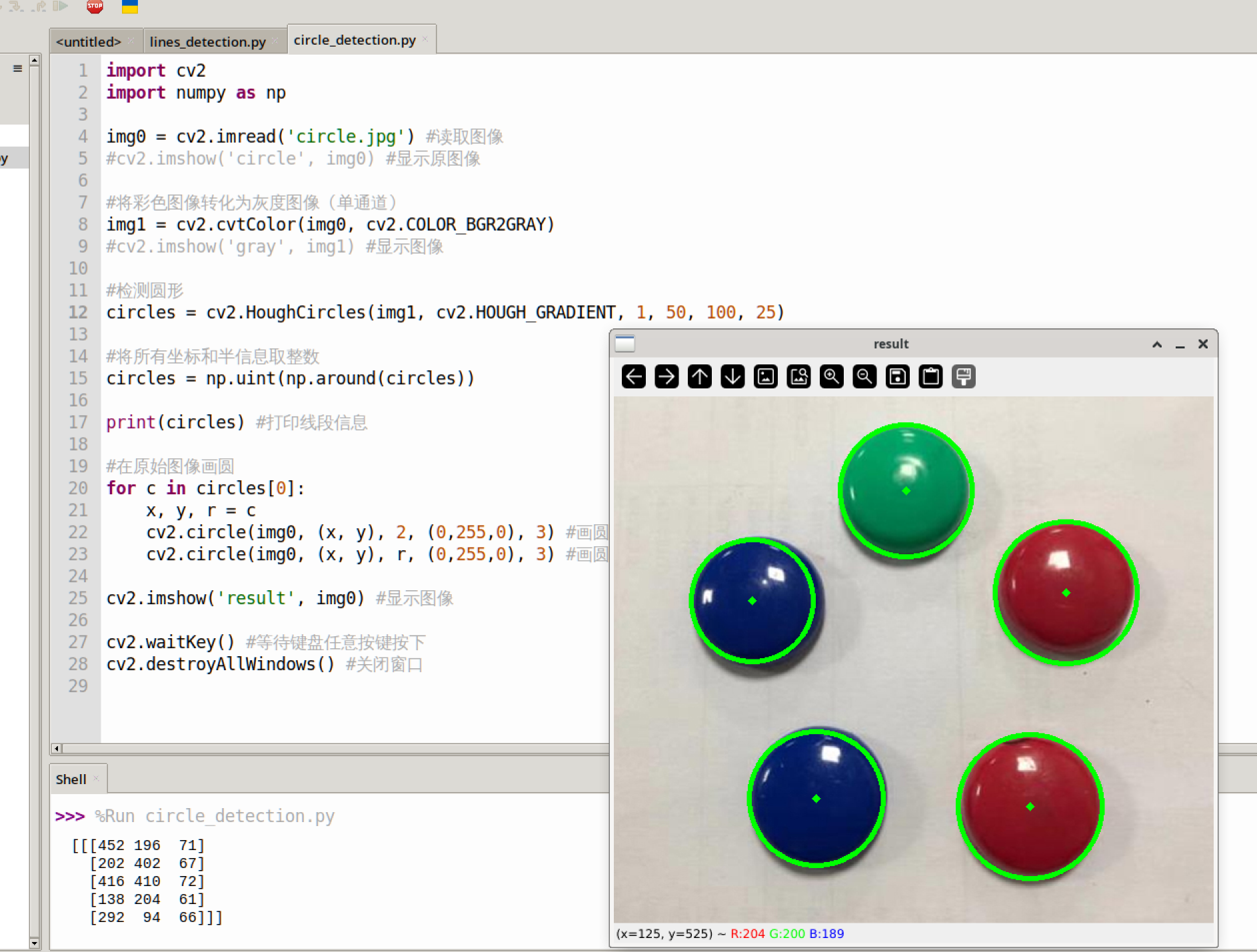
Run the above code on the WalnutPi, and the experimental results are as follows. You can see the circular objects being detected: